

Air Waybill OCR API


4.8/5
(30+ reviews)
Air waybill OCR API that reads every AWB, master or house
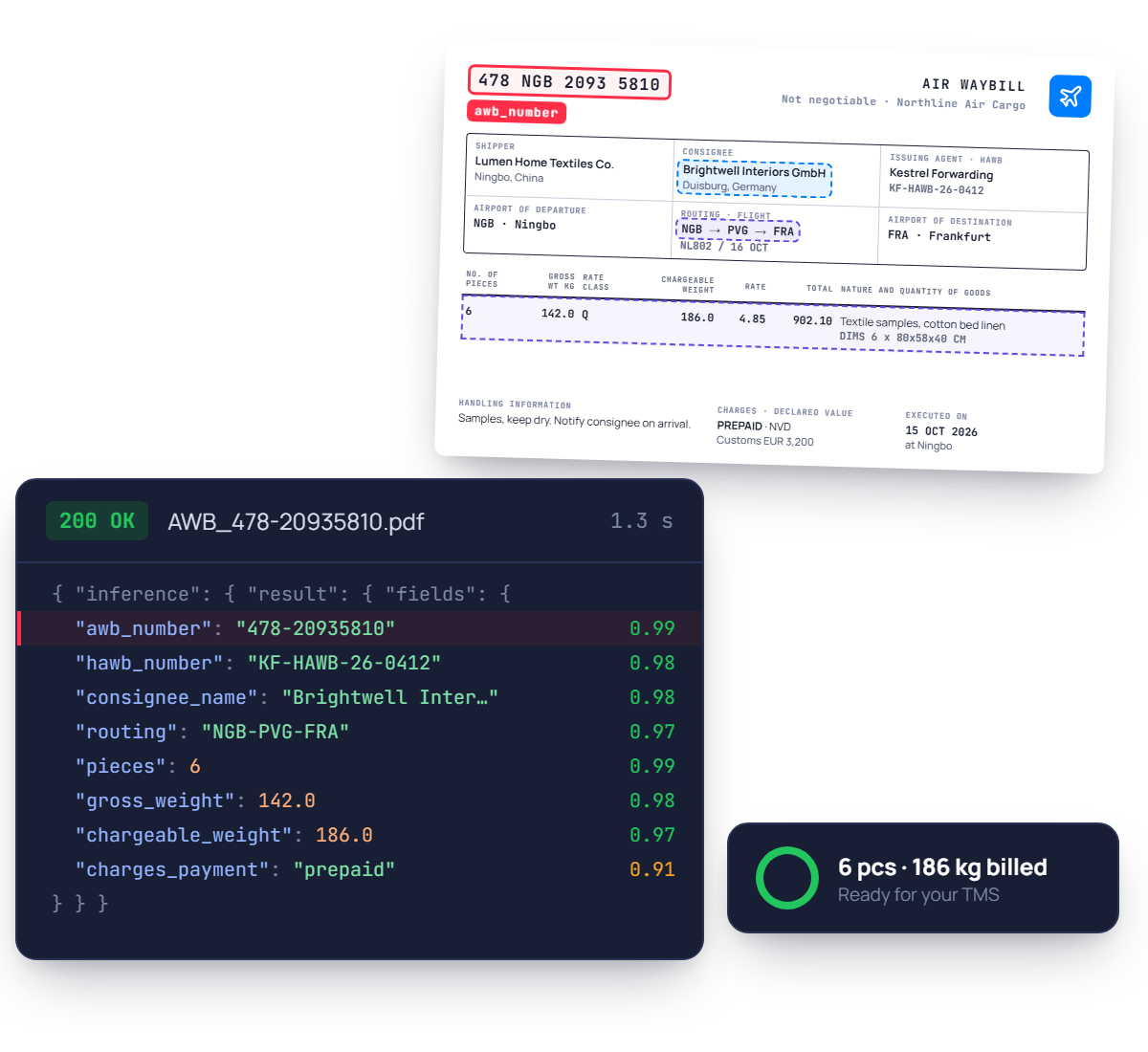
Turn air waybills from airlines and forwarders, PDF, scan or photo, into structured JSON. AWB number, shipper, consignee, airports, pieces and chargeable weight, each with a confidence score.
No credit card required
SOC 2 Type II & GDPR
Trusted by finance and product teams at




Why air cargo paperwork lags behind the flight
Airlines and forwarders each print their own AWB, then send it as a PDF pre-alert or a scan. Ops teams retype AWB numbers, pieces and weights into the TMS while the cargo waits.
Pre-alert received
AWB PDF arrives from the forwarder.
Manual keying
AWB, pieces and weights typed in.
Friction
An 11-digit AWB is easy to mistype.
Weight check
Chargeable weight compared with the quote.
Friction
Overbilled weight goes unnoticed.
Customs prep
Same data keyed again for customs.
Friction
Cargo waits at the airport.
Shipment closed
Finally booked, one AWB at a time.
Every air waybill field you need, as structured JSON
Hover a group to see where it lands in the response. Every value comes back typed, normalised and located on the page, in the schema you defined.
See fields list
AWB numbers
awb_number, hawb_number, issue_date
Parties
shipper_name, consignee_name, issuing_agent
Routing
airport_of_departure, airport_of_destination, routing, flight_number, flight_date
Cargo
pieces, gross_weight, chargeable_weight, nature_of_goods
Charges
rate_class, total_charges, charges_payment, declared_value_customs
Handling
handling_information
{
"awb_number": { "value": "478-20935810" }, "hawb_number": { "value": "KF-HAWB-26-0412" }, "issue_date": { "value": "2026-10-15" },
"shipper_name": { "value": "Lumen Home Textiles Co." }, "consignee_name": { "value": "Brightwell Interiors GmbH" }, "issuing_agent": { "value": "Kestrel Forwarding" },
"airport_of_departure": { "value": "NGB" }, "routing": { "value": "NGB-PVG-FRA" }, "flight_number": { "value": "NL802" },
"pieces": { "value": 6 }, "gross_weight": { "value": 142.0 }, "chargeable_weight": { "value": 186.0 },
"rate_class": { "value": "Q" }, "charges_payment": { "value": "prepaid" }, "declared_value_customs": { "value": 3200.00 },
"handling_information": { "value": "Samples, keep dry. Notify consignee on arrival" },
}
Ready to post, not just to read.
Fields come from a data schema you define in minutes. Dates come back in ISO 8601, weights as numbers, each field with a confidence score.
Built for real AWBs, not a blank template
Dense boxes, carbon copies, handling notes typed over the grid, house bills from every forwarder. The model reads each box where it sits and flags what it is unsure of.

Any airline, any forwarder
Airline masters and forwarder house bills all look different. They come back in one schema you define, with no template per airline or forwarder.

Chargeable weight, checked
Gross and chargeable weight come back as numbers, so you can check each freight invoice against the weight that was actually flown.

Master and house AWBs linked
MAWB and HAWB numbers come back on every document, so a consolidated flight is traced back to each house bill and its customer.
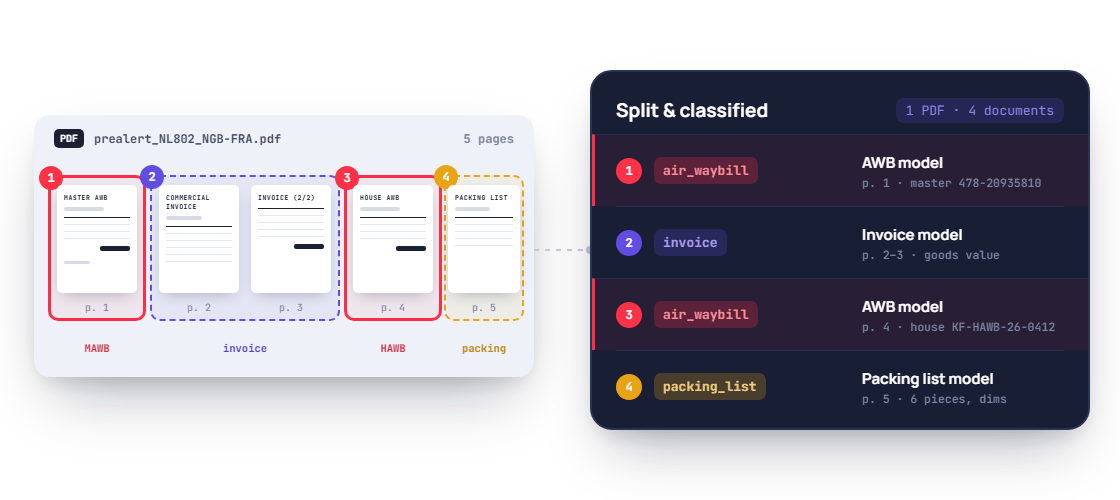
Pre-alerts split by document
Forwarders send pre-alerts with the MAWB, house bills, invoice and packing list in one PDF. Mindee splits the file and classifies each document.
PDF / JPEG / PNG / WEBP / TIFF / HEIC, Master & house AWBs, Multi-leg routing, +50 languages / any currency, Scans & pre-alert PDFs
Air waybill OCR accuracy, field by field
Every field comes with a confidence score, so clean AWBs flow straight to your TMS and unclear boxes go to a reviewer. Test it on your own air waybills in the free trial.
96.4%
Field-level accuracy on header fields
AWB, shipper, airports
99.7%
Accuracy on pieces and weights
Gross and chargeable
0.9s
Median time per air waybill
Single page, synchronous call
A confidence score on every field
Send only real exceptions to a human

Document AI features, better than OCR
Prepare, classify and extract. Mindee delivers high-accuracy extraction for every document format, so you can automate workflows with speed and high reliability.
Data extractor
Classifier
Splitter
Edge detector
Pull the exact fields you need from any document
Pick a ready-made model or describe your own data schema. Every value comes back typed, normalised, located on the page and scored.
- Prebuilt models or your own custom schema
- Tables and line items, across pages
Know what each document is before you read it
The classifier labels every upload with your own classes, so an ID card goes to onboarding and an invoice goes to accounts payable.
- Your own document classes
- Route each type to the right model
One scanned batch in, separate documents out
Send a long PDF from the office scanner. Mindee finds where each document starts and ends, and returns them one by one.
- Page ranges for every detected document
- Up to 200 pages and 100 MB per file
Several documents on one photo? Each gets its own crop
Users photograph three receipts on a desk, or both sides of an ID. Mindee detects each border, returns its coordinates and reads them separately.
- Coordinates for every detected document
- Built for mobile capture flows
Prototype in minutes, go live with the API
Step 1 : Prototype
Run a proof of concept in Make, Zapier or n8n
No code, no IT ticket. Point a mailbox at Mindee and watch the data arrive in a spreadsheet.

Pre-alert received
Forwarder email or portal

Mindee reads the AWB
AWB, airports, weights

Shipment updated
Your TMS, ERP or Sheets

Low-confidence fields sent for review
Slack or email alert to your team
Step 2 : Production
Integrate the API into your platform
Official SDKs, typed responses and webhooks for async processing. Most teams ship the integration in a day.
mindee docs
$ pip install mindee

Your app

Mindee API
Your ERP/CRM

Integrate Mindee into your workflow in minutes with SDKs & no-code tools
Go live in minutes using our verified Zapier & Make.com app with zero coding, or integrate seamlessly via our well-documented REST API built for developers. SDKs available for Python, .NET, Node.JS, Java, Ruby, PHP.
Integrations

Enterprise-grade security
Our API has a SOC 2 Type II certified infrastructure and is GDPR Compliant to ensure your file information remains protected at all times.

EU or US hosting available

GDPR, CCPA Compliant
Learn more
What teams build with air waybill OCR
The same API powers very different products. Here is where it usually starts.
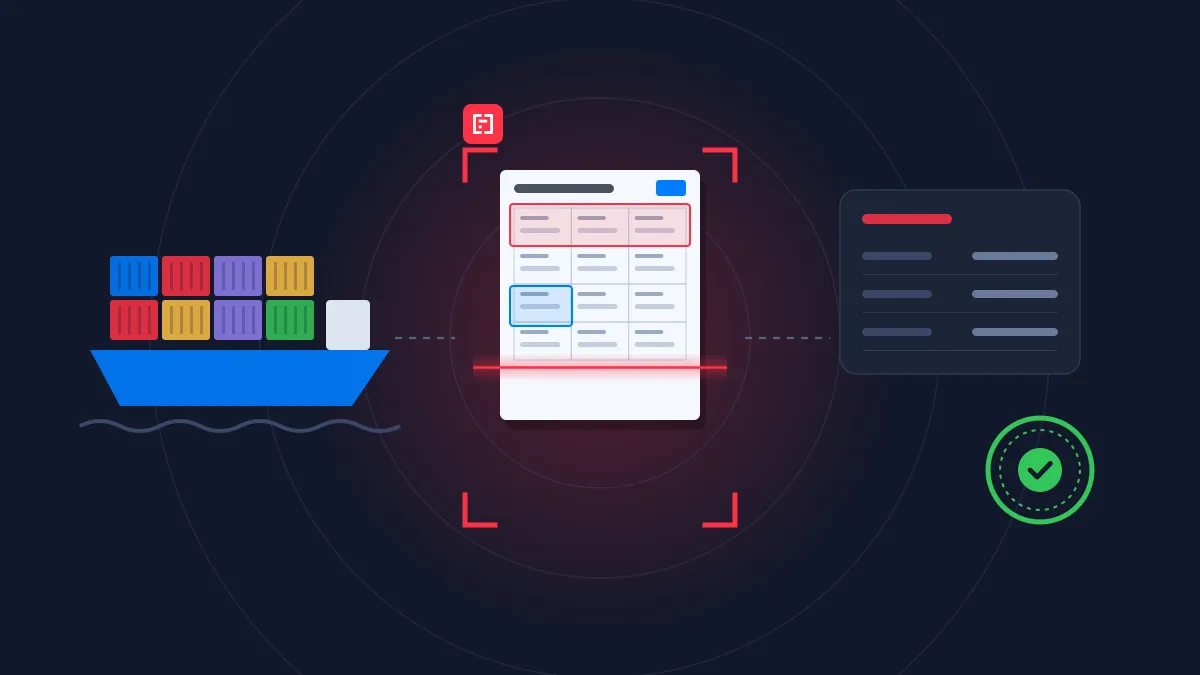
Logistics
Customs clearance
Capture shipping and customs data across every document of a shipment.
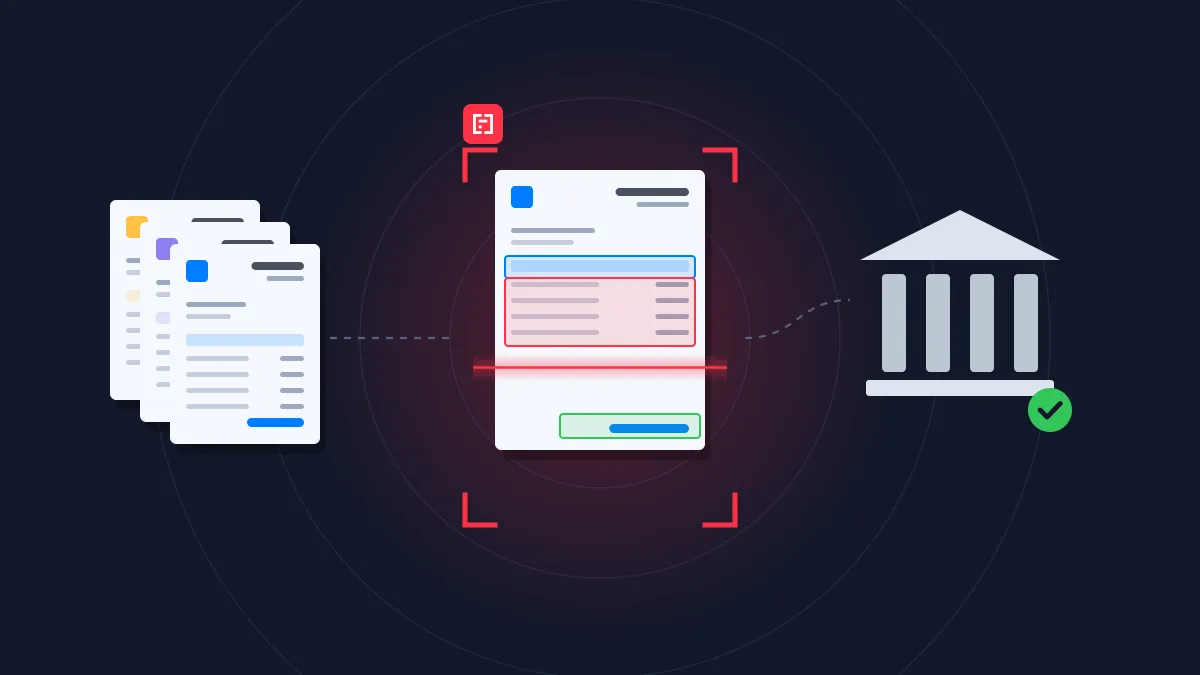
Finance & Accounting
Accounts payable
Extract, match and post supplier invoices without manual data entry.
Rated 4.8/5 by developers and operations teams
4.8


on G2
4.9
on Capterra

Mindee is a web based tool that help us in scanning and reading different type of documents like identity cards, invoices, proposal plans etc and extract all the information with its AI and then it provides all the information and data associated with these documents a structured way.
Gaurav K.
Mindee is a web based tool that help us in scanning and reading different type of documents like identity cards, invoices, proposal plans etc and extract all the information with its AI and then it provides all the information and data associated with these documents a structured way.
Gaurav K.
Mindee works reliably and delivers good performance. The OCR data is accurate, and the API is stable. It works like a charm.

Manuel B.
Mindee is a software that helps us to convert all of our physical business data like bills, invoices, warranty cards, calendar, recipts received to us into a digital documents that can be stored in our drive and can be uploaded in different type of Excel sheets so that all the updates can be maintained and a proper analytics of transactions can be kept by the financial team
Shiv K.
Documents related that Mindee reads




FAQ about Mindee's Air Waybill OCR API
Can't find what you're looking for? Our team answers within one business day.
What is an air waybill?
An air waybill (AWB) is the main transport document for air freight. It is issued by the airline or by its agent, usually a freight forwarder, and serves both as a receipt for the goods and as evidence of the contract of carriage. It shows the shipper and consignee, the airports of departure and destination, the flight details, the number of pieces, the gross and chargeable weight, the dimensions, the description of the goods, the freight charges and any handling instructions. Mindee extracts these fields from paper, PDF or scanned air waybills and returns them as structured JSON, ready for your TMS, ERP or customs systems.
What is an AWB number, and is it the same as a tracking number?
In air cargo, the AWB number is an 11-digit number made up of a 3-digit airline prefix, which identifies the carrier, followed by an 8-digit serial number whose last digit is a check digit. It is used to track the shipment throughout its journey. Express couriers and many e-commerce delivery companies also use the term “AWB number” for their own tracking numbers, which follow their own formats. Mindee extracts the AWB number from any air waybill or courier document, so each shipment can be tracked or matched with your records without manual data entry.
What’s the difference between an air waybill and a bill of lading?
An air waybill is used for air freight, and a bill of lading is used for sea freight. The key difference is legal: a bill of lading can be negotiable and act as a document of title, which means whoever holds the original can claim the goods. An air waybill is always non-negotiable: the goods are delivered to the consignee named on the document, without the need to present an original. This is one reason air freight can be released faster at destination. Mindee processes both documents and identifies which one it is, so each shipment follows the right process.
What’s the difference between a master and a house air waybill?
When a freight forwarder groups several customers’ shipments into one consignment, two levels of air waybills are used. The airline issues a master air waybill (MAWB) to the forwarder for the whole consignment, and the forwarder issues a house air waybill (HAWB) to each shipper for their own goods. Forwarders must then check that the pieces and weights on all the house air waybills add up to the master, and bill each customer correctly. Mindee extracts both types of documents and identifies which is which, so these checks can be automated and discrepancies flagged before they lead to billing errors or customs delays.
About Mindee
Is my data secured and protected during the conversion process?
Yes, your data is highly secured and protected during the entire conversion process. As an enterprise-grade OCR solution, Mindee takes data privacy very seriously. Here are the key security measures in place:
- Certified compliance: Mindee's infrastructure is SOC 2 Type II certified and fully GDPR compliant, ensuring strict industry standards for data protection.
- Encryption: All documents and extracted data are fully encrypted both in transit (during the API call) and at rest.
- Data localization: You have control over where your data is processed, with the option to host and process your data on either EU or US servers.
- Strict privacy: Mindee respects data confidentiality. Your processed documents are not shared with third parties, and your private data is not used to train global AI models.
In short, your sensitive documents are processed in a secure, isolated environment and remain completely under your control.
Is Mindee's OCR API free to use?
We provide a 14 days free trial so you can fully test any of our OCR models — no credit card required. After this, we offer different pricing tiers depending of the volume of pages processed and the features you might need. See the pricing page for more information.
What file formats are supported for JSON conversion?
The supported document formats are:
- PDF (
application/pdf) – While technically a document format rather than an image, it is natively supported for all extraction models. - JPEG / JPG (
image/jpeg) - PNG (
image/png) – Must be non-animated. - WebP (
image/webp) - TIFF / TIF (
image/tiff) – Both single-page and multi-page TIFFs are supported and processed similarly to PDFs. - HEIC (
image/heic) – Apple's High-Efficiency Image Container format.
📌 Important technical limitations to keep in mind:
To ensure the OCR pipeline runs smoothly and successfully returns your JSON, make sure your files adhere to the following constraints:
- Maximum file size: 100 MB per file.
- Maximum page count: Up to 200 pages per document.
- File state: The files cannot be encrypted, and PDFs must not be password-protected.
Ready to stop keying air waybills?
Build your air waybill model from a sample in minutes and send your first AWB to the API, with a team of document processing engineers behind it.
14-day free trial
No credit card required