

document ai


4.8/5 (30+ reviews)
Turn every shipment file into declaration-ready data, line by line
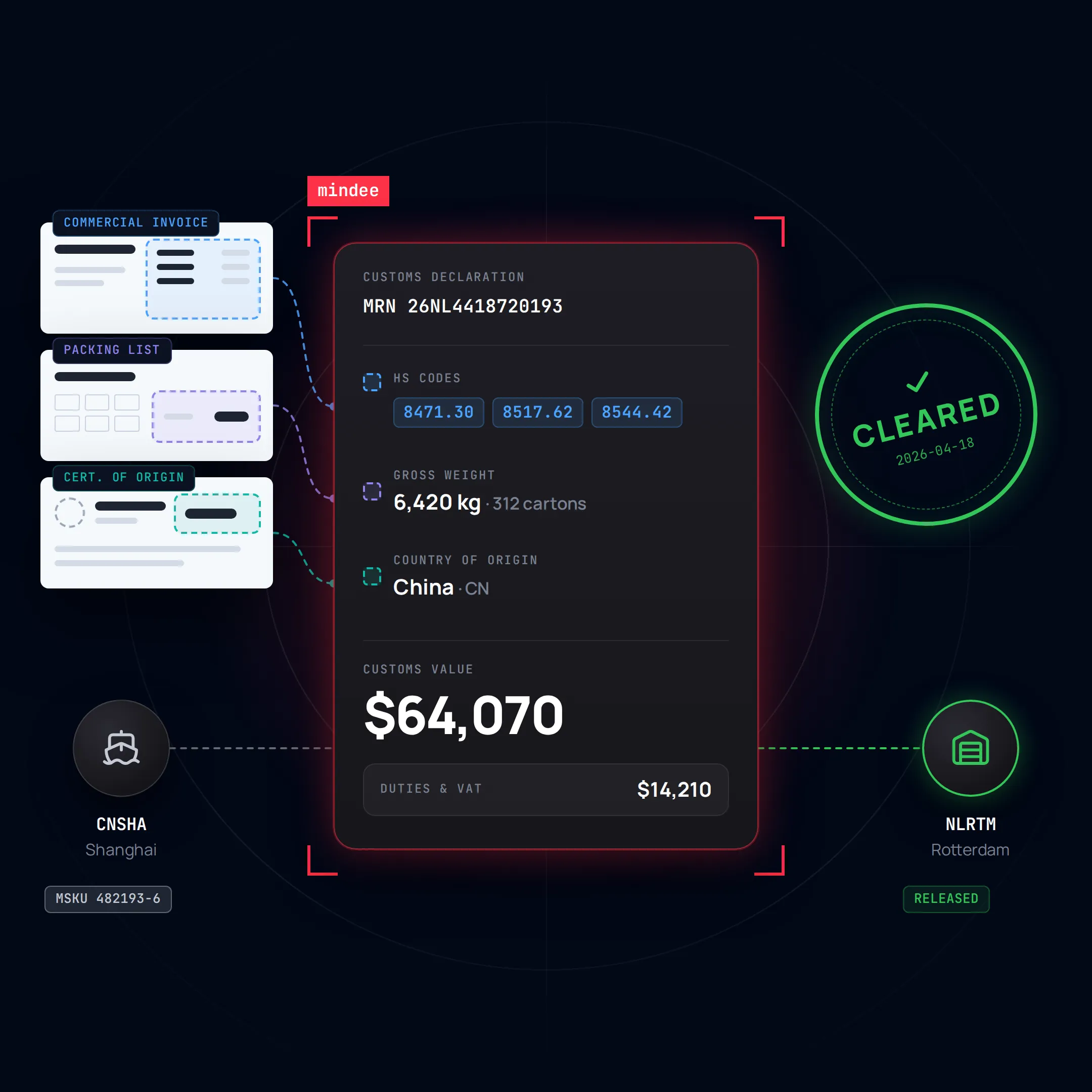
Extract and cross-check commercial invoices, packing lists, bills of lading, air waybills and customs declarations in real time. One API for customs brokers, forwarders, express carriers, cross-border platforms and customs software to prepare declarations faster, catch mismatches before filing and reconcile duties after clearance.
14-day free trial
No credit card required
Trusted by top-tier teams worldwide






Every invoice line retyped by hand is a declaration at risk
Commercial invoices with hundreds of lines, packing lists in every shipper’s format, transport documents scanned at an angle. Each line is keyed into the declaration by hand, and one wrong value, origin or weight means a customs query, a hold, or a penalty for the declarant.

1
Shipment booked
The shipper or carrier sends the shipment file
2
Upload documents
Friction
Invoices and packing lists in every format: HS codes and values retyped by hand.
3
Manual review
Friction
Shipment files pile up before cut-off, lines retyped one by one.
4
Mismatch
Cross-checks
Friction
Weight on the packing list ≠ weight on the bill of lading. Back to step 02.
5
Goods released
If they’re not held at the border
Every document in a shipment file, read in one flow
Mindee recognises each document automatically and extracts the fields you need, ready to be checked against each other.

Auto-classify documents

Invoice
- Invoice number
- Invoice date
- Due date
- Supplier name
- Supplier address
- Supplier VAT number
- Supplier company registration
- Supplier IBAN
- Customer name
- Customer address
- Customer VAT number
- PO & reference numbers
- Line items
- Total net
- Taxes (rate, base, amount)
- Total tax
- Total amount
- Currency
- Payment terms
- Document type (invoice / credit note)

Packing list
- Packing list number
- Date
- Shipper
- Consignee
- Items per package (SKU, description, quantity)
- Total packages
- Invoice / PO number
- Package numbers
- Package type
- Net weight
- Gross weight
- Dimensions
- Total volume
- Marks & numbers
- Country of origin
- Container number

Bill of lading
- B/L number
- Shipper
- Consignee
- Port of loading
- Port of discharge
- Container numbers
- Description of goods
- Notify party
- Carrier
- Vessel name
- Voyage number
- Place of receipt
- Place of delivery
- Seal numbers
- Number of packages
- Gross weight
- Volume
- Freight terms (prepaid / collect)
- Date of issue
- Shipped on board date

Airway bill
- AWB number
- Shipper
- Consignee
- Airport of departure
- Airport of destination
- Flight number & date
- Number of pieces
- Gross weight
- Issuing carrier's agent
- Routing
- Chargeable weight
- Rate class
- Nature & quantity of goods
- Declared value for carriage
- Declared value for customs
- Charges (prepaid / collect)
- Handling information
- Date of issue

Customs declaration
- Declaration number (MRN)
- Declaration type (import / export)
- Exporter
- Importer
- HS codes
- Customs value
- Duties & taxes
- Declarant / customs broker
- EORI numbers
- Country of origin
- Country of destination
- Customs office
- Description of goods
- Quantity
- Gross & net weight
- Currency
- Incoterms
- Transport mode
- Declaration date
- Procedure code
From upload to a checked document process, in five steps
The flow behind document-based customs clearance: classify every attachment, extract parties, Incoterms and each invoice line, cross-check values, quantities and weights across documents, then send declaration-ready data to your customs software and route mismatches to a declarant.

Collect
New shipment email or pre-alert with attachments

Mindee Classify
Invoice, packing list, B/L, air waybill

Mindee Extract
Description, HS code, origin, value, weight…
VERIFY
{Your business rules to check}
Cross-check

Valid data is automated
Declaration-ready data sent to customs software

Exceptions to human
Flag for human review
usual tools for this


... and similar ones!
Prototype in minutes, go live with the API
Test the full document flow with a no-code scenario first. When the results convince your team, plug the same models into your platform.
Step 1 : Prototype
Run a proof of concept in Make
No code, no IT ticket. Send files and see Mindee read them.

Shipment inbox
Commercial invoice, packing list, bill of lading

Mindee Classify & Extract
HS codes, values, weights, Incoterms

Customs software
One record per shipment. Ready to declare.

Slack
Alert on missing documents or mismatched weights
Step 2 : Production
Integrate the API into your platform/workflow
Same models, same results connected to your whole system in a few days.
mindee docs
$ pip install mindee

Your data sources

Mindee API
Your core system
What changes for each team
Engineering, finance and product don't look for the same thing in document-based projects. Here is what each of them gets.

3 teams · 1 platform
Technical
· CTOs, Lead devs
A fast, documented API, live in days, with no extra tech debt

Robust infrastructure and features that scale.
Low effort : up-to-date docs and SDKs
No production surprises : continuous monitoring and drift protection
finance & ops
· CEOs, CFOs, COOs
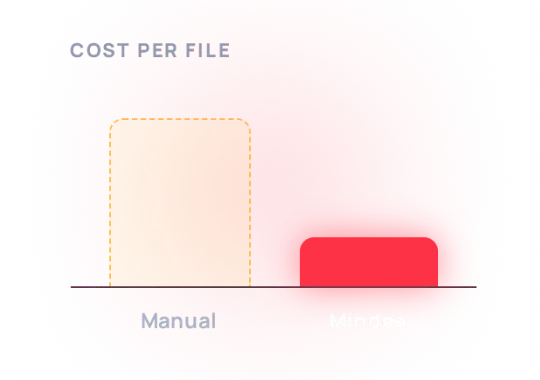
Clear more declarations per declarant and reduce penalties from keying errors
Lower costs, stronger compliance, better margin
Change management eased by no-code templates
Data protected : SOC 2 Type II infrastructure, GDPR compliant
product
· CEOs, Product managers
Read the commercial invoice at upload, so every parcel ships with complete line data
- Line-level data for every parcel, ready for duty calculation
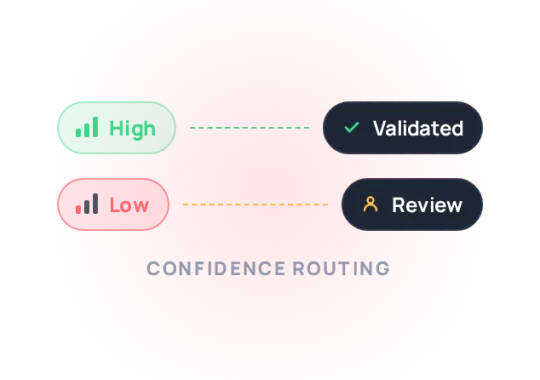
- Missing HS codes, origins or values flagged before filing
- Doubtful files routed to a declarant, never a dead end
Results measured by customers, in average
Teams that clear customs with Mindee spend less time keying in shipment data and release goods faster. Here’s what changes once document checks run on autopilot: less manual review, more shipments handled by the same team, and a fast path from first test to production.

-75
%
less time spent on document checks
TIME PER FILE - Before/After Mindee
10
k
documents processed every month
Volume - last 6 months
4 days
from first API call to production

Test - integrate - live

Integrate Mindee into your workflow in minutes with SDKs & no-code tools
Go live in minutes using our verified Zapier & Make.com app with zero coding, or integrate seamlessly via our well-documented REST API built for developers. SDKs available for Python, .NET, Node.JS, Java, Ruby, PHP.
Integrations

Enterprise-grade security
Our API has a SOC 2 Type II certified infrastructure and is GDPR Compliant to ensure your file information remains protected at all times.

EU or US hosting available

GDPR, CCPA Compliant
Security center
FAQ about this use case
Can't find what you're looking for? Our team answers within one business day.
About Mindee
What documents are needed for customs clearance?
Customs clearance usually requires a commercial invoice (the goods sold, their value and the parties involved), a packing list (the content, weight and packaging of each package), a transport document such as a bill of lading for sea freight or an air waybill for air freight, and often a certificate of origin to apply preferential duty rates. Depending on the goods, licenses or certificates may also be required. Mindee automatically recognizes each of these documents, even when they are sent together in one file, and extracts their data into a single structured shipment file, ready to prepare the customs declaration.
Can Mindee extract HS codes from shipping documents?
An HS (Harmonized System) code is the international product classification used by customs to determine duties and import rules. The first six digits are shared worldwide, and each country adds its own extra digits. When HS codes appear on a commercial invoice or packing list, Mindee extracts them line by line, along with the description, quantity, value and country of origin of each item. Your brokers can then check them, reuse them in the declaration, and spot lines where the code is missing or inconsistent with the product description.
How long does customs clearance take, and how can it be faster?
Customs clearance can take anywhere from a few hours to several days, depending on the country, the goods and whether the shipment is selected for inspection. Many delays come from the documents themselves: missing information, typing errors in the declaration, or inconsistencies between the invoice, the packing list and the bill of lading. With Mindee, the data is extracted in seconds instead of being retyped, and inconsistencies are flagged before the declaration is filed, not after customs raises a query. This saves time on each shipment and reduces the risk of holds and penalties.
Can Mindee cross-check the invoice, packing list and bill of lading?
Yes. Because every document is turned into structured data, you can automatically compare them: the number of packages and gross weight on the packing list against the bill of lading, the quantities and values on the invoice against the packing list, and the shipper, consignee and Incoterms across all documents. Shipments where everything matches move on to the declaration step, and only those with a discrepancy are sent to a customs agent, with the mismatched fields highlighted. Brokers and freight forwarders can then handle more shipments with the same team.



Ready to clear customs without the paperwork?
Extract and cross-check commercial invoices, packing lists and transport documents in real time. Test it on a batch of your own shipment files in minutes.
SOC 2 Type II & RGPD
No credit card required