

document ai


4.8/5 (30+ reviews)
Settle simple claims straight through, and send adjusters a complete file for the rest
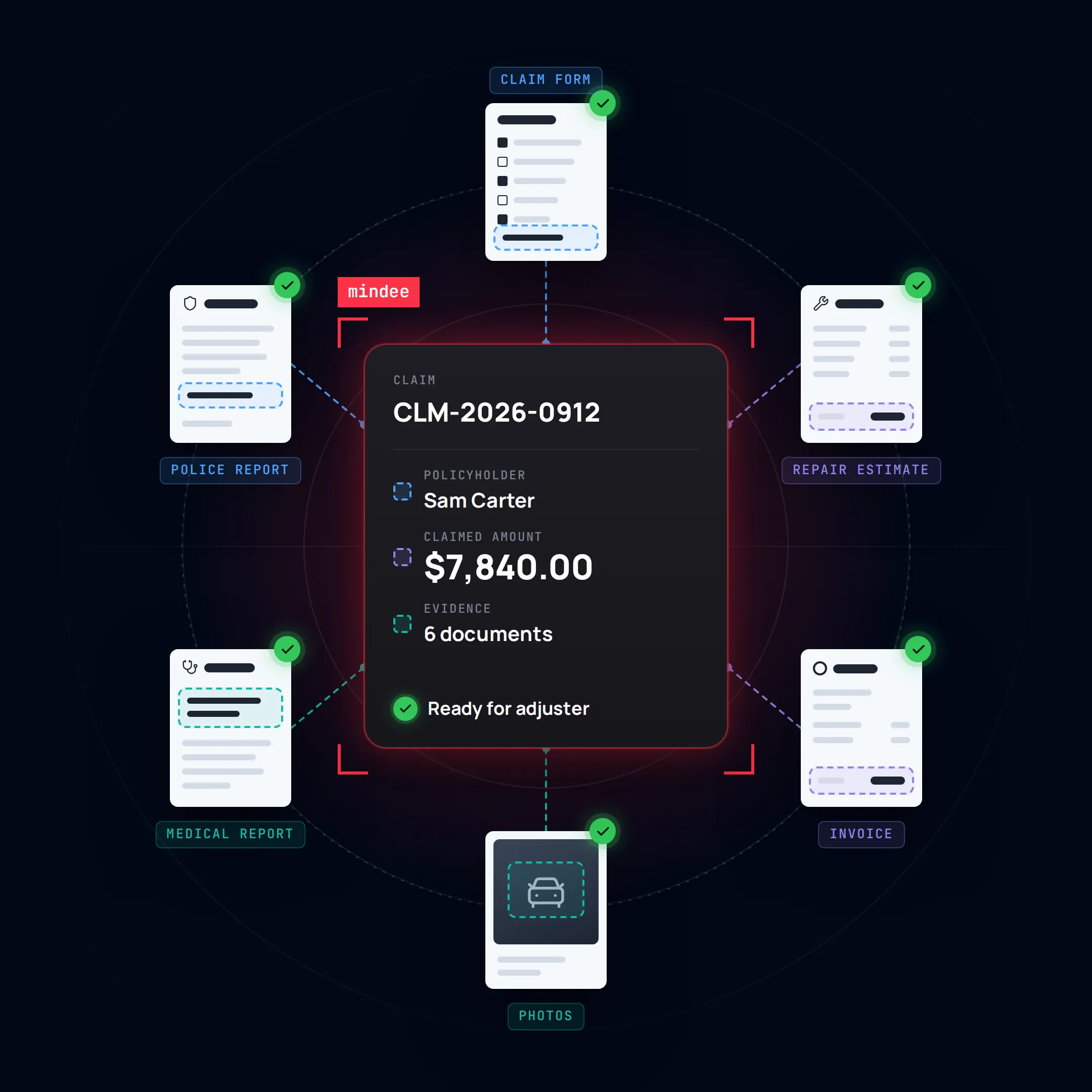
Classify and extract FNOL forms, repair estimates, invoices, receipts and medical bills in real time. One API for carriers, TPAs, insurtechs, independent adjusters and claims software to pay low-risk claims automatically, flag inconsistencies early and route complex files to the right adjuster.
14-day free trial
No credit card required
Trusted by top-tier teams worldwide






Every claim reviewed by hand costs the same, simple or not
Most claims are simple: a receipt, a repair estimate, a payout account. Yet each one waits in the same queue as the complex cases, opened attachment by attachment. A missing invoice, a receipt already paid on another claim, an amount that doesn’t match the FNOL: adjusters spend their days on data entry while policyholders wait and state deadlines keep running.

1
Claim reported
The policyholder files a claim by app, email or phone
2
Upload documents
Friction
Missing invoice or blurry receipt: a new upload is requested by email.
3
Manual review
Friction
Simple and complex claims wait in the same queue, reviewed one by one.
4
Mismatch
Cross-checks
Friction
Amount on the claim form ≠ total on the invoice. Back to step 02.
5
Claim paid
If the policyholder is still a customer
Every document in a claim file, read in one flow
Mindee recognises each document automatically and extracts the fields you need, ready to be checked against each other.

Auto-classify documents

Form
- Form title / type
- Reference number
- Applicant name
- Date of birth
- Address
- Phone
- Policy / account number
- Dates
- Checkbox values
- Free-text answers
- Handwritten text
- Signature presence
- Signature date

Invoice
- Invoice number
- Invoice date
- Due date
- Supplier name
- Supplier address
- Supplier VAT number
- Supplier company registration
- Supplier IBAN
- Customer name
- Customer address
- Customer VAT number
- PO & reference numbers
- Line items
- Total net
- Taxes (rate, base, amount)
- Total tax
- Total amount
- Currency
- Payment terms
- Document type (invoice / credit note)

Receipt
- Merchant name
- Date
- Total amount
- Taxes (rate, amount)
- Category
- Subcategory
- Merchant address
- Merchant phone
- Merchant VAT / registration number
- Receipt number
- Time
- Line items
- Total net
- Total tax
- Tip
- Currency
- Country
- Language

ID card
- Surname
- Given names
- Date of birth
- Document number
- Expiry date
- Nationality
- Sex
- Place of birth
- Issuing country
- Issue date
- Issuing authority
- Address
- Personal number
- MRZ lines
- Photo
- Signature

Driver license
- Surname
- Given names
- Date of birth
- License number
- Expiry date
- License categories
- Address
- Place of birth
- Sex
- Issuing country / state
- Issue date
- Issuing authority
- Category issue & expiry dates
- Restrictions & codes
- Height
- Eye color
- Photo
- Signature

Contract
- Contract type
- Parties
- Effective date
- End date / term
- Amount
- Contract number
- Parties’ addresses
- Signature date
- Renewal terms
- Notice period
- Payment terms
- Currency
- Governing law
- Signatories
- Signature presence
- Policy number
- Coverage
- Deductible

US health insurance card
- Member name
- Member ID
- Group number
- Plan name
- Insurance company
- Plan type
- Payer ID
- RxBIN
- RxPCN
- RxGRP
- Copays (PCP, specialist, ER)
- Effective date
- Dependents
- Customer service phone
- Provider phone
From upload to a checked document process, in five steps
The flow behind straight-through claims: classify every attachment, extract amounts, dates, providers and payout details, check them against the FNOL and the policy, then settle clean low-value claims automatically and route the rest to an adjuster with the inconsistent fields highlighted.

Collect
New claim by app, email or portal

Mindee Classify
FNOL form, estimate, invoice, receipt

Mindee Extract
Provider, date, amount, payout account…
VERIFY
{Your business rules to check}
Cross-check

Valid data is automated
Low-value claim settled automatically

Exceptions to human
Flag for human review
usual tools for this


... and similar ones!
Prototype in minutes, go live with the API
Test the full document flow with a no-code scenario first. When the results convince your team, plug the same models into your platform.
Step 1 : Prototype
Run a proof of concept in Make
No code, no IT ticket. Send files and see Mindee read them.

Claim form
Invoices, receipts, ID card, bank details

Mindee Classify & Extract
Policyholder name, invoice date, total amount, IBAN

Claims management system
One record per claim. Ready to settle.

Slack
Alert on missing documents or amount mismatches
Step 2 : Production
Integrate the API into your platform/workflow
Same models, same results connected to your whole system in a few days.
mindee docs
$ pip install mindee

Your data sources

Mindee API
Your core system
What changes for each team
Engineering, finance and product don't look for the same thing in document-based projects. Here is what each of them gets.

3 teams · 1 platform
Technical
· CTOs, Lead devs
A fast, documented API, live in days, with no extra tech debt

Robust infrastructure and features that scale.
Low effort : up-to-date docs and SDKs
No production surprises : continuous monitoring and drift protection
finance & ops
· CEOs, CFOs, COOs
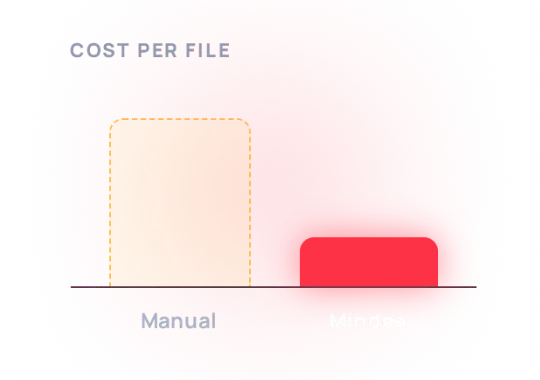
Lower loss adjustment expenses and cut leakage from duplicate or inconsistent documents
Lower costs, stronger compliance, better margin
Change management eased by no-code templates
Data protected : SOC 2 Type II infrastructure, GDPR compliant
product
· CEOs, Product managers
Let policyholders upload everything at once, and pay simple claims in minutes
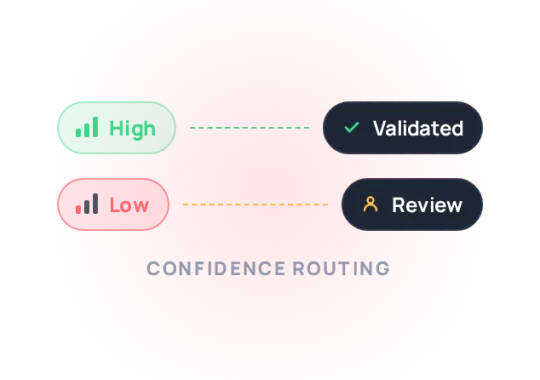
- Missing documents flagged before the claim is submitted
- Several documents in one upload, separated and classified automatically
- Doubtful claims routed to an adjuster or the SIU, never a dead end
Results measured by customers, in average
Teams that handle claims with Mindee spend less time checking documents and pay policyholders faster. Here’s what changes once document checks run on autopilot: less manual review, more claims handled by the same team, and a fast path from first test to production.

-90
%
less time spent on document checks
TIME PER FILE - Before/After Mindee
10
k
documents processed every month
Volume - last 6 months
5 days
from first API call to production

Test - integrate - live

Integrate Mindee into your workflow in minutes with SDKs & no-code tools
Go live in minutes using our verified Zapier & Make.com app with zero coding, or integrate seamlessly via our well-documented REST API built for developers. SDKs available for Python, .NET, Node.JS, Java, Ruby, PHP.
Integrations

Enterprise-grade security
Our API has a SOC 2 Type II certified infrastructure and is GDPR Compliant to ensure your file information remains protected at all times.

EU or US hosting available

GDPR, CCPA Compliant
Security center
FAQ about this use case
Can't find what you're looking for? Our team answers within one business day.
About Mindee
What is claims management?
Claims management is the process an insurer follows to handle a claim, from the first notice of loss to the final payment. It covers receiving the claim, checking the policy and coverage, collecting and reviewing supporting documents, assessing the loss, detecting potential fraud, and settling the claim with the policyholder. Document review is often the slowest step, because claims arrive with many attachments in different formats. Mindee automatically classifies these documents and extracts their data, so claims handlers spend their time on decisions rather than data entry.
What documents are needed for an insurance claim?
It depends on the type of claim, but most include a claim form, the policyholder’s ID and policy number, and proof of the loss. This can be invoices or receipts for damaged or stolen items, repair estimates, a police report for theft or accidents, medical bills for health and travel claims, and photos of the damage. Policyholders often send everything at once, by email or through an app, as PDFs, scans or phone photos. Mindee recognizes each document type, even when several are combined in one file, extracts the key data (amounts, dates, providers, items), and builds a structured claim file that is ready to review.
How long does an insurance claim take, and how can insurers speed it up?
Simple claims can be settled in a few days, while complex ones can take weeks or months, depending on the type of loss, the need for an expert assessment and how complete the file is. Many jurisdictions also set deadlines for insurers to acknowledge, investigate and respond to claims. A large share of the delay comes from collecting missing documents and re-entering their data. With Mindee, documents are processed as soon as they are submitted, incomplete files are flagged immediately so the policyholder can be asked for the missing items right away, and simple, low-value claims can be settled automatically.
How can document extraction help detect claims fraud?
Mindee is not a forensic fraud detection tool, but structured data makes many checks easy to automate. You can detect the same invoice or receipt submitted in several claims, flag purchase dates before the policy start date or after the reported incident, check that the policyholder’s name matches the documents, and spot amounts that don’t add up, such as totals that don’t match their line items. Claims that pass these checks move quickly, and suspicious ones are sent to your fraud team with the inconsistent fields highlighted. This protects your loss ratio without slowing down honest policyholders.



Ready to settle claims without the paperwork backlog ?
Extract and cross-check FNOL forms, estimates, invoices and receipts in real time. Test it on a batch of your own claim files in minutes.
SOC 2 Type II & RGPD
No credit card required