.svg)
.svg)


Sommaire

L' aperçu
Les dirigeants ne s'intéressent pas au « gain de temps » ; ils s'intéressent aux chiffres concrets. La plupart des experts ont déjà vu des projets techniques échouer en conseil d'administration parce que le responsable n'a pas su démontrer le rendement financier. Si vous souhaitez obtenir un budget pour l'automatisation documentaire, vous devez présenter un dossier en béton.
Le calcul du véritable retour sur investissement exige une méthodologie rigoureuse qui compare les coûts cachés du statu quo aux gains d'efficacité quantifiables, à la réduction des risques et aux investissements logiciels.
Dans ce guide, nous auditerons vos coûts actuels, mesurerons les économies directes et effectuerons le calcul final pour justifier votre projet d'automatisation.
Cartographiez vos coûts de traitement manuel actuels
Il est impossible de mesurer un ROI sans point de comparaison ; quantifiez précisément le temps et les coûts de main-d'œuvre liés à votre gestion documentaire actuelle.
Pour établir des indicateurs précis, identifiez le volume mensuel de documents traités. Consultez vos équipes opérationnelles pour compter le nombre exact de factures, de formulaires d'intégration de nouveaux employés ou de contrats qui transitent par leurs bureaux. Ensuite, mesurez le cycle de rédaction et de révision manuelle. Chronométrez le temps nécessaire à l'équipe pour lire, saisir les données dans votre ERP (système de planification des ressources d'entreprise) et acheminer un seul dossier.
Multipliez cette durée moyenne par le taux horaire des employés concernés pour établir votre coût de main-d'œuvre de référence. Par exemple, si trois membres de l'équipe consacrent 60 heures par semaine à la saisie de dossiers de facturation client à 30 $ de l'heure, votre coût de main-d'œuvre de référence s'élève à 7 200 $ par mois.
Les parties prenantes soutiennent souvent que les employés salariés représentent un coût fixe, partant du principe que le temps gagné ne se traduit pas par des économies réelles. Contrez cette objection en mettant en évidence les revenus non perçus. Lorsque des employés hautement rémunérés gèrent des tâches administratives, l'entreprise subit des coûts d'opportunité immédiats. Libérer un assistant juridique de la saisie manuelle de données lui permet de facturer davantage d'heures directement aux clients.
Sélectionnez les flux de travail les plus rentables à automatiser
Ciblez en priorité les flux de travail à fort volume et hautement structurés pour maximiser vos retours sur investissement initiaux.
Élaborez une matrice d'automatisation documentaire pour évaluer quels processus offrent l'impact financier le plus immédiat. Classez vos types de documents sur une grille en fonction de leur volume et de leur complexité. Vos cibles initiales doivent être des documents à fort volume et faible complexité tels que les contrats de bail commercial ou les factures fournisseurs standard. Évitez au début les dossiers très spécifiques et à faible volume, comme les accords de règlement complexes, car le temps de configuration prolongé réduirait votre retour sur investissement initial.
.webp)
Gérer manuellement des flux entrants importants de fichiers mixtes anéantira votre retour sur investissement avant même que l'extraction de données ne commence. L'API Classify de Mindee résout ce problème en agissant comme un moteur de routage intelligent. Il analyse les fichiers entrants et les catégorise automatiquement par type, identifiant s'il s'agit d'un contrat, d'une facture, d'une fiche de paie ou d'une pièce d'identité. Cela permet d'acheminer uniquement les documents à haute valeur ajoutée directement vers votre pipeline d'extraction.
{{cta-consideration-1="/in-progress/global-blog-elements"}}
Suivez vos réductions prévisionnelles de temps, de coûts et de risques
Les économies brutes se composent des réductions de main-d'œuvre directe et des gains indirects liés à la diminution des erreurs humaines et à l'accélération des délais de traitement.
Les économies directes constituent l'indicateur le plus clair. Estimez le pourcentage de temps gagné par processus. Si un flux de travail automatisé réduit le temps de traitement de 10 minutes à 2 minutes, vous obtenez une réduction de 80 %. Calculez les coûts de main-d'œuvre exacts récupérés sur un exercice fiscal sur la base de ce pourcentage.
.webp)
Vous devez également quantifier les gains indirects. Prenez en compte l'atténuation des risques de conformité, l'évitement des coûts de litiges passés dus à des modifications non autorisées, et une mise sur le marché plus rapide. Les capacités d'IA modernes favorisent ces réductions de risques spécifiques. L'API Extract de Mindee fournit des scores de confiance (Faible, Élevé, Certain) pour chaque champ extrait. Cette fonctionnalité spécifique permet aux développeurs d'envoyer automatiquement les données vers une base de données lorsque l'IA est certaine, tout en redirigeant en toute sécurité les documents confus ou illisibles vers un humain pour une vérification manuelle.
.webp)
Enfin, incluez les économies secondaires. Si vos flux de travail automatisés s'intègrent à une solution de signature électronique, calculez l'élimination complète des frais liés au papier, à l'impression et au stockage physique.
Calculez le coût total de l'investissement en automatisation
Calculez le coût total de possession de la solution d'automatisation documentaire, incluant les frais de configuration, de maintenance et d'abonnement.
Listez vos coûts d'investissement initiaux. Cela comprend la mise en œuvre initiale du logiciel, les heures d'ingénierie nécessaires pour créer des modèles d'extraction personnalisés, et l'intégration avec vos outils existants comme votre logiciel de gestion du cycle de vie des contrats (CLM).
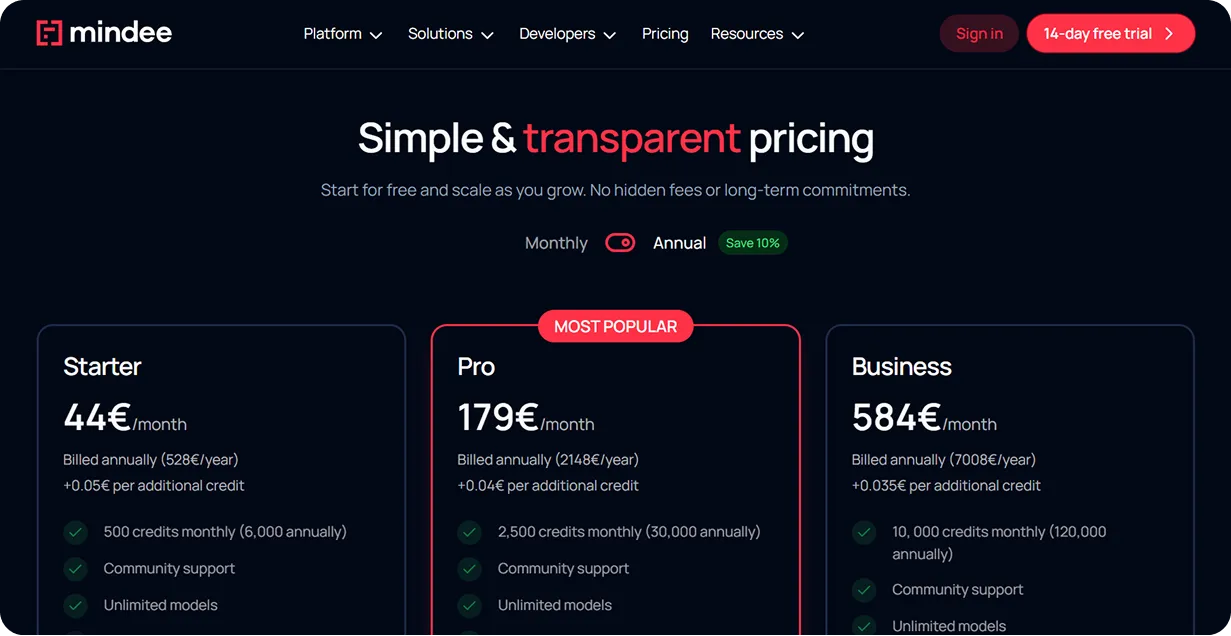
Ensuite, prenez en compte les coûts opérationnels récurrents, notamment les licences utilisateur, l'utilisation de l'API et la formation. La tarification de Mindee offre des repères prévisibles : l'offre Starter à 44 € par mois inclut un minimum de 500 crédits, tandis que l'offre Pro à 116 € par mois permet d'utiliser jusqu'à 25 000 crédits. Il est important de noter que la fonctionnalité RAG illimitée (apprentissage continu), qui permet au système de mémoriser les corrections et de les appliquer instantanément à des documents similaires à l'avenir, est débloquée dès l'offre Starter, sans être réservée à l'offre Pro. Intégrer ces coûts précis par palier et ces fonctionnalités mises à jour dans votre tableau de bord garantit des projections fiables.

Excluez les coûts irrécupérables des anciens systèmes remplacés afin d'éviter de fausser votre nouveau dossier commercial.
Appliquez la formule du ROI pour justifier votre dossier commercial
Utilisez les calculs financiers standards du ROI pour convertir vos données de référence, vos économies et vos coûts en un pourcentage clair pour vos parties prenantes.
Définissez le rendement net en soustrayant vos coûts d'investissement totaux de vos économies totales projetées. Appliquez ensuite la formule standard :
.webp)
Prenons l'exemple d'un cabinet de services professionnels qui dépense actuellement 50 000 $ par an en gestion manuelle de documents. Ils investissent 10 000 $ dans l'automatisation et économisent 40 000 $ en main-d'œuvre et en réduction des risques.
- Rendement net = 40 000 $ (Économies) - 10 000 $ (Coût) = 30 000 $
- ROI = (30 000 $ / 10 000 $) * 100 = 300 %
Un retour sur investissement de 300 % constitue une justification commerciale solide qui saura convaincre la direction.
Conclusion
Le calcul du retour sur investissement des solutions d'automatisation documentaire exige un audit rigoureux de l'existant, l'identification des cas d'usage pertinents et la projection des économies directes et indirectes par rapport au coût total de possession. Basez-vous sur des chiffres réels plutôt que sur des estimations.
{{cta-conversion-1="/in-progress/global-blog-elements"}}
Avant de vous lancer dans un déploiement à l'échelle de l'entreprise, réalisez une preuve de concept. Commencez par un type de document à fort volume et intégrez une API comme celle de Mindee en utilisant ses SDK open-source officiellement pris en charge pour des langages tels que Python, Node.js ou Java. Valider votre retour sur investissement estimé dans un environnement réel vous fournira les données précises nécessaires pour réussir votre passage à l'échelle.

À propos

.svg)
.webp)

.webp)