.svg)


4.8/5 (30+ reviews)

Automate document processing with AI-powered API
From simple photos to complex PDFs or handwritten files, our API turn your document data into structured JSON with high‑reliability. Zero model training required. Any alphabets, any languages supported.
No credit card required
SOC 2 Type II & GDPR


.png)
Trusted by top-tier teams worldwide






Mindee API capabilities that cut the time lost to document processing
Everything you need to go from first test to production, whether you write code or not.
Custom extraction models
Start from a prebuilt model and adjust its data schema, or define every field from scratch for your own documents. No template, no retraining from zero.
Any format, any language
Send PDFs, images or scans in any language and get the same structured JSON back.
Advanced OCR features
Confidence scores and bounding boxes on every value, plus continuous learning to refine your model over time.
Live testing, from day one
Test your model in Mindee's platform as soon as it is set up, and update it on the go with the AI assistant.
SDKs and no-code integrations
Official client libraries for developers, and no-code connectors to automate without writing a line.
Enterprise-grade security
Host your data where you need it, in the EU or the US, on SOC 2 Type II certified APIs that are GDPR and CCPA compliant.
Document AI features, better than OCR
Prepare, classify and extract. Mindee delivers high-accuracy extraction for every document format, so you can automate workflows with speed and high reliability.
Data extractor
Classifier
Splitter
Edge detector
Pull the exact fields you need from any document
Pick a ready-made model or describe your own data schema. Every value comes back typed, normalised, located on the page and scored.
- Prebuilt models or your own custom schema
- Tables and line items, across pages
Know what each document is before you read it
The classifier labels every upload with your own classes, so an ID card goes to onboarding and an invoice goes to accounts payable.
- Your own document classes
- Route each type to the right model
One scanned batch in, separate documents out
Send a long PDF from the office scanner. Mindee finds where each document starts and ends, and returns them one by one.
- Page ranges for every detected document
- Up to 200 pages and 100 MB per file
Several documents on one photo? Each gets its own crop
Users photograph three receipts on a desk, or both sides of an ID. Mindee detects each border, returns its coordinates and reads them separately.
- Coordinates for every detected document
- Built for mobile capture flows
Have a specific document in mind?
Start from the document types our customers process every day. Pick one to see what comes back from the API.
Invoices
Line items, quantities and totals
Receipts
Totals, taxes and merchant details
Invoice OCR
Line items, quantities and totals from any language and layout.
Receipt OCR
Itemised totals, taxes and merchant details from receipts in any format.
Passport OCR
Identity data, MRZ codes and expiry dates from any international passport.
Resume parsing
Skills, work history and contact details from very different CV layouts.
Bank statement OCR
Transactions, balances and account details from multi-page statements.
Driver license OCR
License numbers, categories and addresses from different regional formats.
Do more than LLMs, with Mindee in your stack...
.png)
Implement rules based on confidence scores
Every extracted value comes with a confidence level, so you can auto-integrate certain data and send the rest to human validation.
.png)
Identify and reference sources of the decision
Mindee returns the coordinates of every extracted field, making each piece of data traceable for auditing and verification interfaces. An LLM can't do it reliably.
.png)
Use a deterministic approach that requires no extra setup
LLMs can vary its output or invent values even at temperature 0. With Mindee, the same document always returns the same normalized result, so you can map fields straight to your CRM or ERP without retry logic.
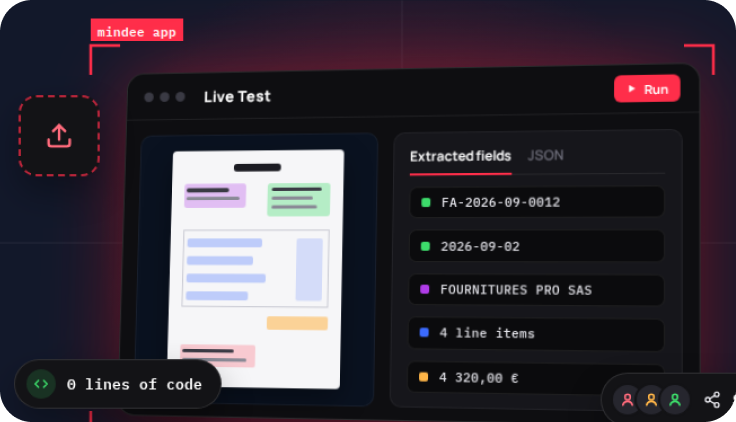
Prototype and test your configuration with Mindee’s platform
Upload sample documents on Mindee's platform, define the fields you need and validate results before writing a single line of code.
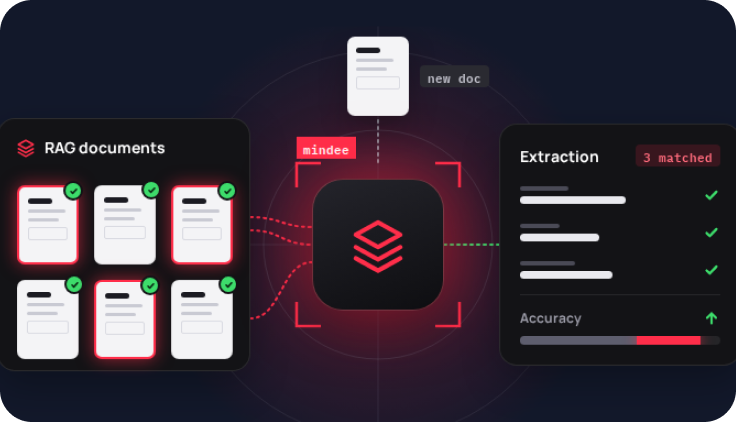
Fine-tune your extraction performances with RAG
Enrich your model with your own validated/annotated documents: each new extraction draws on real examples from your data. Accuracy improves on your specific layouts and edge cases.
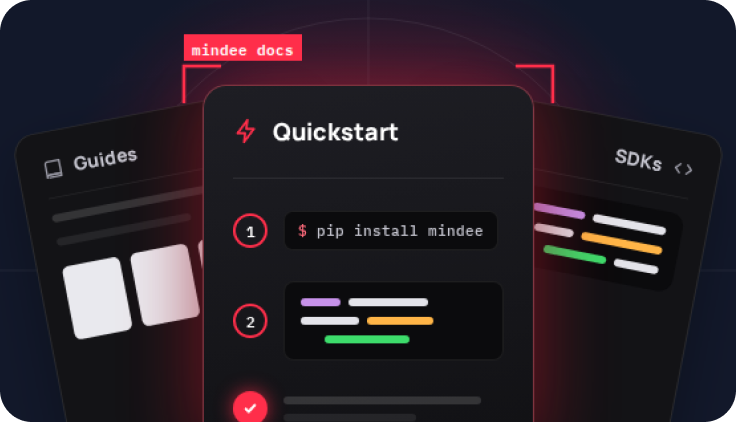
Rely on documentation built for document processing
Use-case guides, ready-to-use SDKs and code samples take you from first API call to production without piecing together generic LLM tutorials.
View Mindee vs LLMs
Companies around the world, run on Mindee
Best finance, HR and accounting platforms ship document capture as a native feature of their product.
.svg)



.svg)
.webp)



.svg)


.webp)



Enterprise-grade security, based in Paris
SOC 2 Type II audited and GDPR compliant, with encryption in transit, at rest and configurable data retention.
Reliable infra for any stack. Deploy via SDKs, no-code tools, or manual API calls to fit your unique business needs.
Learn more about document processing



.webp)

FAQ about Mindee
Can't find what you're looking for? Our team answers within one business day.
About Mindee
Is Mindee's OCR API free to use?
We provide a 14 days free trial so you can fully test any of our OCR models — no credit card required. After this, we offer different pricing tiers depending of the volume of pages processed and the features you might need. See the pricing page for more information.
Is it cheaper to build or buy a document processing API?
You can play with the Mindee vs LLMs calculator to find your specific breakeven point, but in short :
BUY if :
- You are processing standard documents (Invoices, IDs, Receipts, Tax forms)
- You need speed-to-market and high accuracy immediately
- Document processing is a utility/commodity for your business, not the product
- You want predictable monthly spending without managing GPU hardware
BUILD if :
- Your documents are highly proprietary (e.g., secret blueprints, unique internal forms)
- You have strict data sovereignty requirements (Data cannot leave your private cloud)
- You want to own the Intellectual Property for a core business differentiator
- You process >10M pages/year, making the "API tax" higher than a 5-person engineering team
How much technical experience do I need to create a model?
Very little. You create a model in the Mindee platform by describing the fields you want to extract (or starting from a template), with no coding and no machine learning expertise required. There’s no training step before you can use it: you can test it on your own documents right away.
To use the model in production, you’ll need basic development skills to call the API, which the Mindee SDKs and code samples make simple. Many teams also connect Mindee through no-code tools like Zapier or Make.
What are some real-world examples of automated document data extraction?
Automated data extraction removes manual entry from document-heavy workflows. Common examples include:
Accounts payable: Invoices are processed “touchlessly.” The API extracts the invoice number, tax ID, totals, and full line items (product, quantity, unit price) so payments can be processed automatically.
Two-way matching and reconciliation: Extracting the PO number from a purchase order and the SKUs from a delivery note lets businesses automatically check that what was received matches what was ordered, leaving a clean audit trail.
Customer onboarding: When a user uploads an ID or utility bill, the API extracts their name, date of birth, expiration date, and address, verifying identity in seconds and reducing sign-up drop-off.
See more examples in our customer stories.
Is integration complex, or does it require training time?
No. Unlike traditional "On-Premise" solutions that take months to deploy, Mindee’s API-first approach allows you to go live in minutes. The complexity of document processing usually depends on whether you choose to build an infrastructure or consume an intelligent service.
Mindee simplifies the experience by two ways :
- Zero-training time : Mindee models are pre-trained on millions of data points. Whether it’s an invoice, a receipt, or an ID card, the API already "knows" what it’s looking at. You don't need a Data Science team; you just need an API key.
- Plug-and-play : Mindee is a plug-and-play REST API. With our dedicated SDKs (Python, Java, PHP, and more), a developer can integrate full document automation into your existing software with just a few lines of code.
What security certifications do you have ?
We maintain a robust security and privacy framework, anchored by our SOC 2 Type II certification, which validates the long-term effectiveness of our internal controls.
We are also fully compliant with global privacy regulations, including GDPR and CCPA, ensuring the highest standards of data protection.
Additionally, our infrastructure is HIPAA-eligible, and we can support healthcare-specific requirements and Business Associate Agreements (BAAs) upon request.
Process documents at scale, without engineering hassles
Start preparing, classifying and extracting document data in minutes, with a full team of engineers dedicated to you.
SOC 2 Type II & GDPR
No credit card required