
.svg)
.svg)


Table of Contents

The snapshot
Engineering teams frequently stall their automation roadmaps by fundamentally misunderstanding the limits of legacy OCR and overestimating the implementation complexity of modern ICR.
When consulting with enterprise architects, you may encounter the same recurring misconceptions. It is critical to separate marketing fluff from technical reality.
Deploy OCR to digitize standardized print
OCR is the foundational technology for structured, printed text, relying on strict pattern matching to convert static images into machine-readable data.
The traditional OCR setup utilizes feature extraction—the mathematical process of isolating geometric shapes like intersecting lines and curves—and document segmentation to process standardized fonts and block letters. Keep in mind that building extraction pipelines, deploying open-source tools like Tesseract OCR or libraries like PyTesseract proves highly effective for high-volume repositories of clean, structured documents due to their rapid processing speed.
.webp)
However, OCR operates on rigid logic. These tools hit a hard wall when faced with character set limitations, mixed layouts, or degraded image quality. If you feed standard OCR a native digital PDF, it executes flawlessly. If you feed it a crumpled, scanned invoice from a third-party vendor, the extraction accuracy plummets because the software lacks the capacity to infer context beyond the raw pixels.
{{cta-awareness-1="/in-progress/global-blog-elements"}}
Leverage ICR to decode complex handwriting
ICR advances beyond basic pattern recognition by leveraging neural networks to evaluate context, unstructured formats, and varied cursive writing.
Automation pipelines frequently break the moment humans enter the loop. Powered by machine-learning algorithms and Natural Language Processing (NLP)—technology that enables computers to interpret text meaning much like humans do—ICR bridges this operational gap. It provides self-learning capabilities that incrementally improve over time, making it uniquely suited for the chaos of unstructured documents.
When processing handwritten notes or highly variable forms, ICR evaluates the entire context of a word rather than isolating individual characters. For example, if a scanned letter resembles a messy hybrid between an "l" and an "e", contextual analysis evaluates the surrounding letters to mathematically infer the correct spelling. This drastically elevates accuracy rates on handwritten notes and edge cases that reliably break traditional OCR scripts.
.webp)
Balance speed and accuracy against compute constraints
OCR dominates in raw processing speed and minimal hardware requirements, whereas ICR delivers superior accuracy on complex inputs at the cost of heavier computational demands.
When designing a solution, engineers constantly trade speed for intelligence. OCR relies on lightweight image preprocessing. It scales effortlessly for massive throughput demands and requires minimal server resources. ICR uses continuous adaptive learning and contextual analysis.
This architecture demands significant compute power and high-quality training data, but it brings long term ROI by drastically reducing downstream manual data entry.
Analyzing error logs from thousands of processed invoices clarifies the divide. OCR fails predictably on a blurry, handwritten invoice, simply returning blank fields. ICR deploys its neural networks to predict and accurately extract the vendor name.
Historically, ICR's heavy training data requirement presented a barrier to entry. Modern platforms mitigate this natively. Mindee utilizes a RAG (Continuous Learning) feature: instead of completely retraining an AI model when it misreads a novel document layout, developers correct the error once. The system registers this correction and instantly applies it to similar documents in the future, increasing accuracy continuously.
Clear up common misconceptions about extraction capabilities
Engineering teams frequently stall their automation roadmaps by fundamentally misunderstanding the limits of legacy OCR and overestimating the implementation complexity of modern ICR.
When consulting with enterprise architects, we constantly encounter the same recurring misconceptions. It is critical to separate marketing fluff from technical reality:
- Misconception: Standard OCR tools can read anything if the scan quality is high enough.
- Reality: Scan quality is only half the battle. A traditional OCR setup is mathematically constrained to recognize standardized fonts and block letters. Even on a flawless 600 DPI scan, standard OCR pdf tools will fail entirely on mixed layouts or fields that trigger strict character set limitations.
- Misconception: ICR is just "OCR for cursive."
- Reality: ICR is an entirely different technological paradigm. While it excels at cursive writing, its true power lies in context understanding. Dedicated ICR software doesn't just read strokes; it uses NLP to predict vocabulary based on the surrounding sentence. This deep contextual awareness also enables robust multi-language support, allowing the engine to seamlessly switch vocabularies without manual reconfiguration.
- Misconception: Implementing ICR requires a dedicated machine learning team.
- Reality: Five years ago, it was true. Today, developers do not need to build neural networks from scratch. Modern engineering teams simply integrate lightweight ICR SDKs that wrap complex API calls into simple, type-safe functions, eliminating the need for specialized AI researchers on staff.
{{cta-consideration-1="/in-progress/global-blog-elements"}}
Align document types to maximize automation
Matching your specific document formats to the correct extraction technology ensures maximum data accuracy and minimizes exception handling across different industries.
Deploying costly machine learning to read predictably formatted data wastes compute resources. OCR thrives on rigid layouts and machine-generated text. Engineering teams must leverage it strictly for high-volume, structured tasks:
- Finance & Operations: OCR excels at extracting data from invoices sent via standard accounting software, or parsing dense tables in printed financial statements.
- Archival & Logistics: It provides the raw speed necessary for digitizing books at an industrial scale or instantly recognizing license plates at automated toll booths.
Conversely, ICR proves essential for human-generated content where unpredictability is the norm. Workflows require it for messy, high-stakes documents:
- Healthcare & Insurance: ICR is mandatory for modernizing medical pipelines, whether you are digitizing patient records from the 1990s, decoding doctors' signatures in historical patient notes, or navigating the chaos of insurance claims processing where claimants submit hastily written descriptions of accidents.
- HR & Legal: It effectively manages unstructured inputs by analyzing legal documents filled with margin annotations, or processing handwritten forms like retail handwritten job application forms.
- Government & Education: Institutions rely on ICR for grading assignments or extracting data from complex, handwritten declarations submitted for customs or tax purposes.
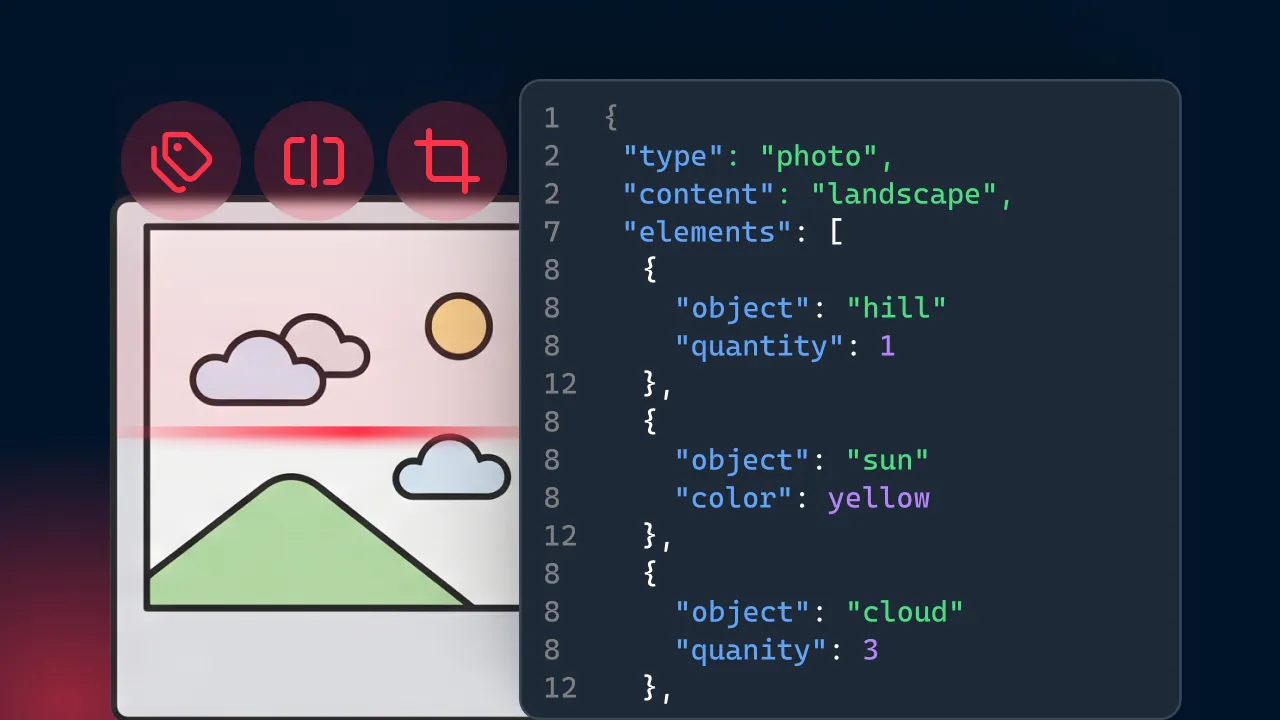
In practical enterprise environments, operations teams rarely receive purely structured or purely unstructured batches. Mindee’s core Extract product resolves this by automatically pulling structured data from unstructured documents like PDFs or photos. It provides off-the-shelf AI models for common documents like invoices and receipts. Furthermore, if a user uploads a single photo containing three separate receipts, Mindee's Crop tool automatically detects, isolates, and crops each distinct document into a separate file, ensuring the data remains segregated before extraction begins.
Consolidate workflows via intelligent document processing
Modern enterprises integrate both OCR and ICR via APIs into centralized Intelligent Document Processing (IDP) systems rather than deploying them in isolated silos.
Building isolated pipelines for printed and handwritten text accumulates technical debt. Modern IDP platforms act as dynamic routing engines, automatically applying traditional OCR APIs for printed zones and advanced ICR for handwritten fields within the exact same document.
Developers use Mindee’s Classify tool to handle this initial triage. It analyzes incoming files and automatically categorizes them by type (identifying a contract versus a pay slip). This functionality allows systems to sort documents instantly and route them to the correct extraction pipeline. If that incoming file is a massive 50-page PDF containing mixed mail, the Split tool uses AI to detect where each individual document begins and ends, automatically separating the large file into logical, distinct assets.
.webp)
To maintain absolute data integrity, these consolidated platforms enable hybrid human-AI review systems. Mindee’s API returns Confidence Scores (Low, High, Certain) for every extracted field. This allows backend systems to automatically push data to a database when the AI proves certain, while safely routing confusing or blurry documents to a human operator for manual review.
Audit technical requirements to optimize total cost of ownership
A successful procurement strategy must balance expected processing volumes and integration capabilities against the total cost of ownership.
Before writing a single line of code, technical leads must build a selection framework to evaluate deployment models. Cloud-based services offer fast API integration and immediate scalability. Historically, on-premises deployments were strictly required for companies enforcing heavy data governance, but modern cloud APIs adapted.
For strict compliance and privacy laws like GDPR, higher enterprise tiers allow administrators to utilize Data Processing Localization, forcing Mindee to process documents only in specific geographic regions.
API integration overhead directly impacts your engineering budget. Mindee provides Official SDKs in languages like Python, Node.js, Java, PhP, Ruby and .NET providing developers with type safety and built-in error handling without writing boilerplate HTTP code. Operations teams lacking dedicated software engineering resources can leverage No-Code connectors like Zapier, N8N, and Make. For heavy enterprise workloads handling multi-page documents, Webhooks actively push the JSON results back to the host system once the AI finishes extracting the data, maintaining a fast and responsive user interface.
Finally, align architecture with anticipated volume. Costs scale predictably from Mindee's Starter tier (€44/month for 500 credits) for rapid prototyping, up to Enterprise deployments tailored for massive volumes exceeding 250,000 credits per year.
Final thoughts
OCR remains the undisputed master of predictable print, delivering raw, cost-effective speed for standardized layouts.
ICR operates as the sophisticated decoder for unpredictable human handwriting, leveraging context and neural networks to interpret data accurately.
Elite engineering teams abandon the "OCR vs ICR" debate. Instead of managing fragmented codebases, they adopt an AI-driven document parsing platform that automatically deploys the exact right technology for every pixel on the page. If you want to bypass the manual setup entirely, consider exploring our Platform signup to test these AI engines against your own documents today.
About

.svg)
.webp)

.webp)
.webp)