.svg)
.svg)


Table of Contents

The snapshot
Processing more than 10,000 invoices a month requires structural automation rather than merely expanding human headcount. The hidden financial and operational costs of manual data entry scale exponentially. Scaling financial operations successfully necessitates an automated, AI-driven architecture. In this guide, we will explore the bottlenecks of traditional setups, map out the ideal intelligent document processing architecture, and explain how to select the right platform.
Confront bottlenecks in manual financial workflows
Traditional processing systems break down under high volumes, leading to expensive exceptions, compliance risks, and strained vendor relationships.
Finance controllers often resist migrating away from comfortable legacy Enterprise Resource Planning (ERP) environments due to the perceived risk of implementation downtime. However, relying heavily on manual data entry causes severe processing delays and increases payment inaccuracies. Rigid, template-based OCR architectures fail when introduced to high-volume invoice processing. Invoices possess inherent variability. Non-PO invoices (bills submitted without a pre-approved purchase order) and wildly divergent vendor formats guarantee traditional systems will generate a mountain of exceptions that human operators must still resolve manually.
Architect an automated pipeline for high volume invoice processing
A scalable invoice architecture relies on intelligent document processing rather than rigid, template-based OCR.
To handle enterprise-scale workloads, you need a pipeline that operates seamlessly. It begins with ingestion: gathering digital files from a cloud portal, email queues, or physical scans. The architecture frequently fractures at the point of heterogeneous document batches.
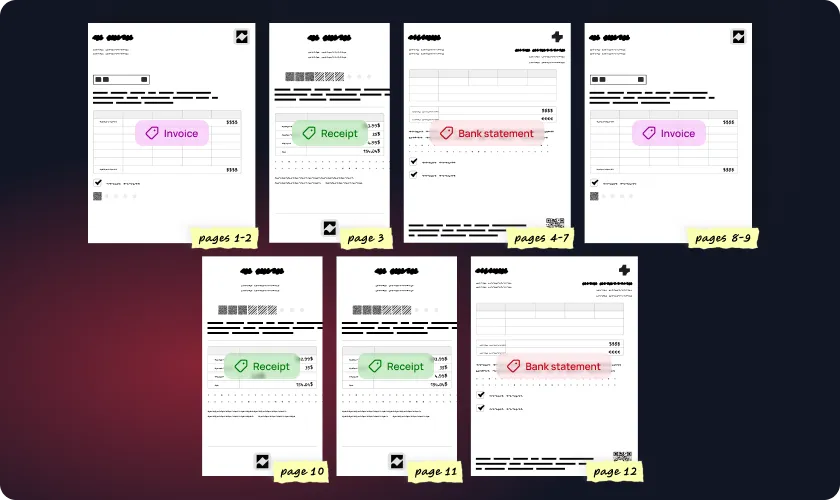
When a vendor submits a 50-page PDF containing a consolidated batch of daily mixed mail, you require a specialized mechanism to process multi-page files. You can implement the Split tool from Mindee. The AI detects where each individual document begins and ends, automatically splitting the large file into logical, separate documents. Once separated, the system functions as an intelligent routing engine. By utilizing the Classify tool, the system analyzes incoming files and automatically categorizes them by type, identifying whether a file is a contract, an invoice, or a pay slip. Routing these to the correct extraction pipeline using computer vision and a template-free approach drastically reduces error rates compared to legacy methods.
Select key capabilities for your automation solution
Enterprise-grade processing requires robust security, seamless ERP integration, and highly accurate AI-powered data capture.
When selecting an automated invoicing platform, the extraction engine serves as your core component. It must automatically pull structured data like totals, taxes, dates, names, and table line items from unstructured documents. Extracting data requires absolute accuracy to be useful.
.webp)
Confidence scores (a reliability metric indicating the AI's certainty in its extracted data, typically ranked as Low, High, or Certain) are absolutely critical for this workflow. As a developer, this metric allows you to automatically push data to your database when the AI is certain, while safely routing confusing or blurry documents to a human for manual review. Building this logic is incredibly straightforward if your provider offers official SDKs, or client libraries, in languages like Python, Node.js, Java, .NET (C#), Ruby, and PHP. These officially supported, open-source libraries wrap the API, making it incredibly easy to send files and parse the results without writing boilerplate HTTP code.
{{cta-conversion-1="/in-progress/global-blog-elements"}}
Integrate AI-driven tools to future-proof operations
The future of finance lies in dynamic workflows and centralized portals that adapt instantly to evolving business requirements.
System obsolescence destroys automation ROI. In a traditional setup, when a major supplier modifies their invoice layout, your development team must spend days writing custom-built rules or retraining the machine learning model entirely.
Modern architectures bypass this friction through continuous learning mechanisms. Instead of fully retraining an AI model when it struggles with a new document layout, operators correct the error once utilizing RAG (Continuous Learning). The system remembers this correction and instantly applies it to similar documents in the future, getting smarter on the fly. Combined with predictive coding and customized workflow automation, these AI-driven systems provide unprecedented data visibility and continuously improve cash flow management over time.
Final thoughts
Automating high-volume workloads transforms an inefficient bottleneck into a strategic, highly scalable asset. By selecting the right pricing tier for your page volume, the platform reduces operational drag immediately while compounding its value through active machine learning. By eliminating manual data entry and implementing an AI-powered document parsing platform, your team can abandon administrative paperwork, sign up for free to test the API, and prioritize vendor relationships alongside strategic financial forecasting.

About

.svg)


.webp)
%20in%20document%20automation.webp)