.svg)
.svg)


Table of Contents

The snapshot
Accounts payable bottlenecks overwhelmingly originate from manual document verification. The average enterprise processes upwards of 10,000 invoices a month, and when you rely on human eyes to compare an invoice against a purchase order and a receiving report, the average cost per invoice hovers dangerously close to $15.
Industry experts may have watched AP clerks hunt for line-item discrepancies across multi-page PDFs, cross-referencing unit costs on dual monitors. It is a slow, error-prone chore that bleeds money. 3-way matching automation eliminates manual data entry, prevents fraud, and accelerates accounts payable workflows to capture massive, immediate ROI.
Understand the differences between 2-way and 3-way matching
3-way matching adds a vital layer of security by verifying the receipt of goods, whereas 2-way matching only compares the invoice to the purchase order. 2-way matching (the process of verifying billing amounts against the initial PO) is often sufficient for service-based businesses. If you buy $50,000 worth of software licenses or consulting hours, this two-document check is usually enough to authorize payment.
.webp)
Conversely, 3-way matching is absolute table stakes for physical goods. If you run a manufacturing firm buying steel bearings, you need a receiving report to guarantee physical delivery before releasing funds. Without the third document, organizations risk paying for items damaged in transit, short-shipped, or entirely absent. Industry data suggests that nearly 10% of all B2B invoices contain discrepancies. When you scale that across thousands of monthly transactions, failing to enforce a 3-way match means you are hemorrhaging cash on unverified inventory.
.webp)
Master the automated 3-way matching workflow
Automation software digitizes the intake, data extraction, and validation steps to instantly approve or flag invoices without human intervention. The process kicks off with invoice capture and intelligent data extraction. Mindee is an AI-powered document parsing platform that provides developer-friendly APIs to automatically extract structured data from unstructured documents. Mindee Extract automatically pulls structured data (totals, taxes, dates, names, table line items, etc.) from unstructured documents like PDFs or photos. Mindee offers "pre-built" AI models for common documents (invoices, receipts, ID cards, passports) as well as a custom API builder to train your own models for company-specific documents.

Once digitized, the system compares header or line-item level data against your exact purchase order rules. The real power lies finding an API which gives you a confidence score (e.g., Low, High, Certain) for every extracted field. This lets developers automatically push data to their database when the AI is certain, while safely routing confusing or blurry documents to a human for manual review. Furthermore, Mindee utilizes RAG (Continuous Learning); instead of fully retraining an AI model when it struggles with a new document layout, you just correct the error once. The system remembers this correction and instantly applies it to similar documents in the future, getting smarter on the fly.
Secure financial operations with internal controls
Automated matching intrinsically enforces compliance by maintaining a strict audit trail and preventing unauthorized or duplicate payments. According to the Association of Certified Fraud Examiners, billing schemes are the most common form of asset misappropriation, costing businesses a median of $100,000 per occurrence.
Relying on strict audit rules rather than human oversight prevents fraud and overpayments entirely.
The system flags duplicate invoices instantaneously, acting as a tireless policy agent for your internal control procedures. Configurable approval workflows ensure that if a discrepancy falls outside of custom tolerance rules (such as a variance exceeding $5 or 2%), the exception routes directly to the correct stakeholder. To aid this human review, Mindee's API doesn't just give you the extracted text; it provides the exact X/Y geometric coordinates of where that text lives on the page. This is great for building user interfaces where a user can click a piece of data and see exactly where it was pulled from on the original image.
.webp)
Accelerate AP efficiency to capture hard ROI
Speed and accuracy in the purchase-to-pay workflow translate directly to financial savings through early payment discounts and reduced labor costs. Consider a mid-sized distributor whose supplier offers a standard 2% discount if invoices are paid within ten days. Because it takes their AP team two weeks to physically chase down a delivery receipt and manually verify the purchase order, they miss that ten-day window every single time. That is free money lost entirely to process friction.
By automating the data extraction and matching steps, they shrink that approval cycle from weeks to minutes. They capture those early payment discounts consistently and turn their AP department from a cost center into a strategic yield generator.
By automating AP, they also expect to drop their processing cost from 15$-12$ to 2$-1$ per invoice
Integrate seamlessly with ERP and AP Systems
To maximize efficiency, automated 3-way matching must integrate directly with existing enterprise resource planning (ERP) systems via API connections or pre-built integrations. Data silos kill automation. Native ERP syncs ensure your vendor management, goods receipt, and procurement data remain unified across the tech stack.
Engineering teams leverage Mindee's officially supported, open-source SDKs (Client Libraries) to wrap the API, making it incredibly easy to send files and parse the results without writing boilerplate HTTP code. Supported Languages include Python, Node.js, Java, .NET (C#), Ruby, and PHP. If you don't want to write any code at all, Mindee integrates with popular automation platforms like Zapier, N8N and Make (formerly Integromat).
For heavy workloads and multi-page documents, asynchronous webhooks allow you to send the document to Mindee and tell it, "Here is the file, ping this specific URL on my server when you are done". Once the AI finishes extracting the data, it actively pushes the JSON results back to your system.
{{cta-conversion-1="/in-progress/global-blog-elements"}}
Deploy real-world use cases for immediate impact
Organizations handling high volumes of partial deliveries or complex, multi-page invoices experience the fastest time-to-value from automated matching capabilities. Consider a hospital receiving thousands of surgical supplies. Deliveries arrive in fragmented shipments daily. An automated 3-way matching process tracks these partial deliveries via line-item level matching. It ensures unit costs align perfectly with the original purchase order and the goods receipt, even when a single order fulfills across ten different deliveries over a month.
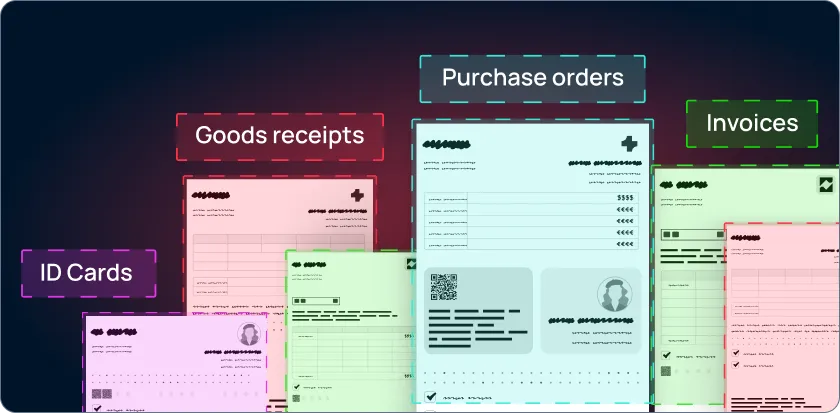
In enterprise AP environments, handling large batches of mixed mail is a notorious bottleneck. Mindee’s Split tool handles multi-page files (like a 50-page PDF containing a whole day's worth of mixed mail). The AI detects where each individual document begins and ends, automatically splitting the large file into logical, separate documents. Then, an intelligent routing engine like Mindee Classify analyzes incoming files and automatically categorizes them by type (e.g., identifying whether a file is a contract, an invoice, a pay slip, or an ID). This allows you to sort documents instantly and route them to the correct extraction pipeline.
Final thoughts
Automating the 3-way match transforms a tedious AP chore into a strategic, secure, and cost-saving operation. By removing human friction from the data verification process, businesses tighten financial controls while freeing up staff for high-level analytical work. As AI-powered data extraction tools become the standard, AP departments that embrace automation today will operate with zero-touch, error-free invoice processing tomorrow.

About

.svg)


.webp)
%20in%20document%20automation.webp)