
.webp)

API DEV-First


4.8/5 (30+ reviews)
Invoice OCR, Receipt OCR & Document Data Extraction API
Extract text and structured data from invoices, receipts, and any documents. Get clean, reliable JSON in milliseconds — ready for automation.
Test an invoice or receipt

No credit card required
.webp)
Trusted by top-tier teams worldwide






Everything you need from a production-ready OCR API
Invoice OCR & text extraction
Automatically extract invoice numbers, dates, line items, totals, taxes, vendors, and addresses from PDFs and scanned invoices. Built for real invoices — not clean samples.
Receipt OCR for expense data
Extract merchant name, transaction date, currency, totals, VAT, and line items from receipts, photos, and mobile scans.Handle messy, real-world receipts at scale.
Structured document data extraction
Go beyond raw OCR. Extract structured fields and receive consistent, usable JSON ready for accounting, ERP, or data pipelines.No post-processing required.
Multi-document & layout-aware OCR
Process invoices, receipts, forms, contracts, and mixed document batches — with or without templates. Adapt to changing layouts without breaking your pipeline.
Confidence scores & reliability signals
Every extracted field includes a confidence score so you can automate decisions, route exceptions, and reduce manual review.No blind trust. No guessing.







.svg)
Most advanced AI OCR features getting your document extraction to the next level
Our AI-driven OCR API provides high-precision data extraction for all document formats, enabling businesses to automate workflows with speed and total reliability.
Accelerate processing by automatically breaking multi-page uploads into separate documents. Our solution detects document boundaries to split batches into distinct records ready for extraction.
Automate your workflow by sorting incoming documents instantly. Mindee OCR API distinguishes between document types, routing each file to its specific category for streamlined data management.
Digitize multiple documents scanned on a single page with automated detection. Mindee OCR API isolates and crops each item into a standalone file, ensuring every record is processed individually.
More than just an API. Refine, test and customize.
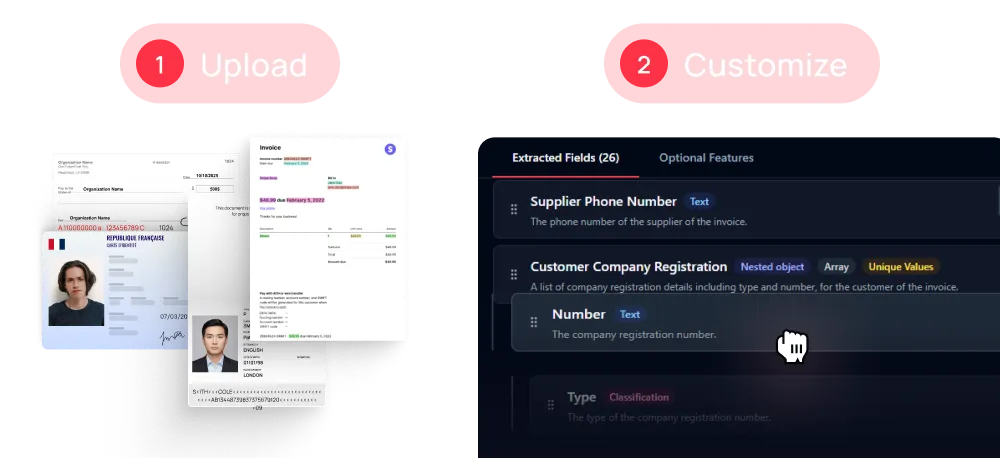
Custom your model from scratch or start with a template among 30+ on Mindee interface
Build customizable extraction models with interactive data schemas.

Multi-language support
Parse your document in every language.

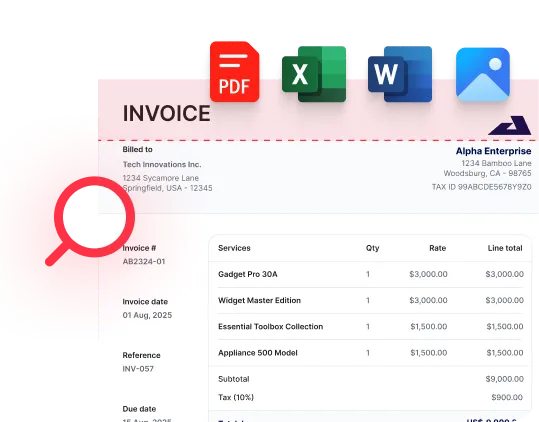
Upload docs in any formats
Add .pdf, .jpg, .png, .docx, .xlsx, ... and more. No time spent to convert.

Integrate Mindee into your workflow in minutes
SDKs and low-code tools supported.
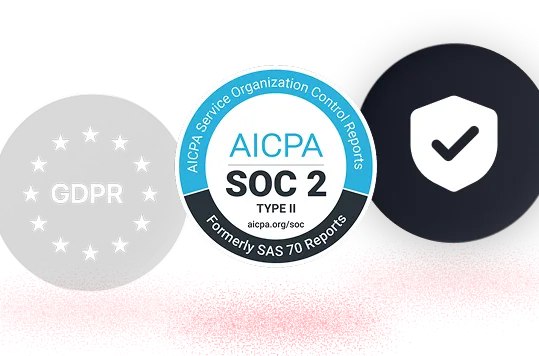
Your data is protected

EU hosting available

GDPR, CCPA Compliant
Exclusive features about Mindee for power‑users
.webp)

Feature
Confidence scores
Keep an eye on AI work with labels

Feature
Polygons
Highlight your variables for better understanding, before & after extraction

Feature
RAG
Build your own documents library to enrich your model and manage edgecases

FAQ about Mindee's OCR API
Is a data document extraction API the same as a web scraping API ?

No. While both "extract data," the underlying technology is worlds apart.
- Web scraping APIs: Designed to navigate DOM structures, bypass CAPTCHAs, and collect data from HTML/CSS. They search for the right information before to extract anything.
- Data extraction APIs (Document AI): Specifically built to process "unstructured visual files" like PDFs, scanned images, and emails. They don't look for <div> tags; they use OCR and spatial vision to understand the layout of a physical page
Can I extract complex tables from scanned PDFs with Mindee ?
Yes,with Mindee,you can test this feature by signing up for free here and uploading a sample file. Line items and complex tables recognition will be fully supported from PDFs or any image formats.
This is where generalist APIs often fail. Standard OCR might give you a "word soup."
For complex tables (multi-line rows, merged cells, or nested headers), you need a vision-aware pipeline.
Pro tip: Generalist LLMs often hallucinate table structures. For "messy" financial documents, look for APIs that use specific vision models rather than just generic text-to-text models
How do I extract 10MB+ PDFs or long documents ?
With Mindee, you can handle up to 100MB size per file and up to 200 pages.
Large files (e.g., 100-page mortgage) should never be processed in a "request-response" (synchronous) loop. We can talk about two API methods :
- Asynchronous processing (Polling) : You submit the file, receive a job_id, and the API processes it in the background.
- Webhooks : Once complete, the API "pings" your server with the structured JSON. This is the gold standard for any Automated data extraction API setup for every language (Python, Node JS, Java, etc.)
How accurate are complex tables & line items across different layout ?
Mindee could be the best fit for you if you need a reliable API, to extract line items variations with high-level accuracy.
Accuracy varies significantly based on the layout. While "Key-Value Pairs" (like Total Amount or Date) are easy, Line Items (Description, Quantity, Unit Price) are the hardest to parse because every vendor uses a different table style.
Benchmark Tip: Don't trust the marketing "99% accuracy" claim. Test the same set of 50 "messy" invoices across vendors to see who misses line items or confuses the "Quantity" with the "Tax Rate."
How do I guarantee valid JSON structured format ?
Getting JSON is step one; getting valid JSON is step two. Most modern APIs, like Mindee allows you to define a data schema. To ensure your database doesn't crash:
- Use Pydantic (Python) or Zod (TypeScript) to validate the API output.
- If the extraction doesn't meet the schema (e.g., a missing mandatory invoice_id), flag it for human review.
What about data extraction from handwriting or multilingual documents ?
Mindee supports every alphabets, every languages, every handwritten human-readable documents.
Most top-tier APIs now support handwriting and 100+ languages. However, expect a 15-20% drop in confidence for cursive handwriting compared to printed text. For niche languages, verify if the OCR engine supports the specific character set (e.g., Cyrillic or Arabic).
What are some real-world examples of automated document classification ?
By identifying the type of document at the point of entry, organizations can automate the routing of files to the correct workflows without a single second of manual triaging.
Here are some of the most impactful real-world examples of automated document classification:
In the accounts payable department, classification is a game-changer for departments that receive massive bulk PDF attachments from vendors. The API can instantly distinguish between an invoice, a credit note, and a monthly statement. This ensures that a credit note isn't mistakenly processed as a bill, preventing costly payment errors and streamlining the entire financial cycle.
It is equally essential for two-way matching and reconciliation workflows. Often, a single scan might bundle a purchase order (PO) with its corresponding delivery note. Automated classification identifies the boundary and the specific type of these two distinct records, allowing them to be cross-referenced automatically for audit purposes. By classifying them first, the system knows exactly which extraction engine to use for the PO vs. the delivery receipt.
For customer onboarding, this technology creates a frictionless user experience. A new client can upload a single "onboarding packet" containing their ID card, a utility bill for proof of address, and a signed contract. The classification engine recognizes each item within the packet and routes them to specialized extraction models—such as a passport API or a utility bill API—for instant, automated verification.
Similarly, in vehicle fleet management, automated classification enables the seamless digitization of complex maintenance folders. Insurance certificates, vehicle logbooks, and repair invoices are often scanned together in a single batch. The classification logic ensures that each document is correctly identified and filed under the right vehicle asset, allowing fleet managers to track compliance and maintenance history without any manual sorting or filing.
You can check more real-life examples of how companies leverage this technology by visiting customer stories.
Is Mindee's OCR API free to use?
We provide a 14 days free trial so you can fully test any of our OCR models — no credit card required. After this, we offer different pricing tiers depending of the volume of pages processed and the features you might need. See the pricing page for more information.
